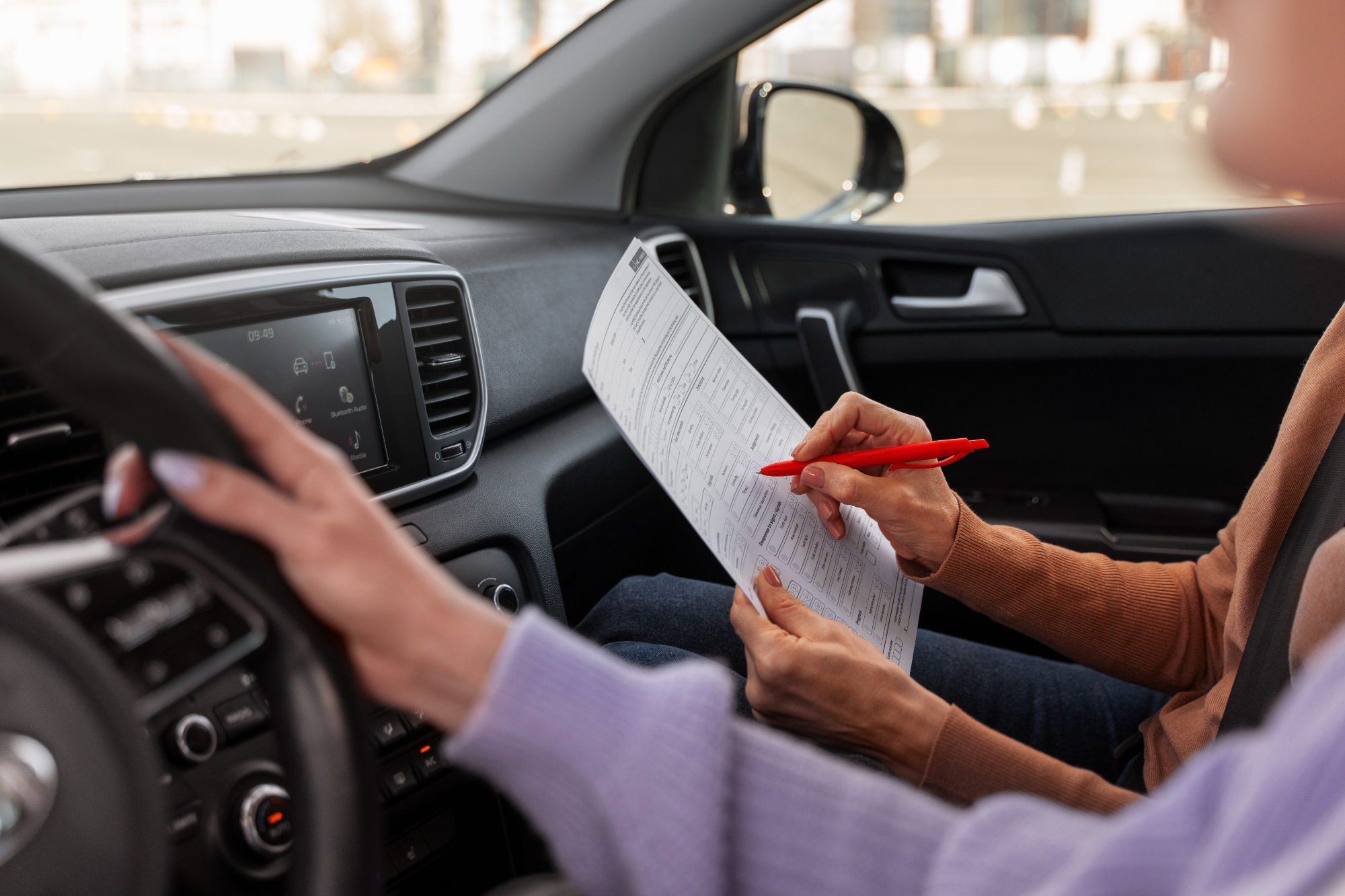
Getting your L or P plates is an exciting milestone for driving independence. But it comes with important rules and restrictions to keep everyone safe on Victoria’s roads. 80% of drivers with P plates and 55% of L plates involved at least one risky driving condition in their 10 recent trips.
So, it's crucial to know the rules for L and P plate drivers. They include
- logbook hours,
- L and P plates displaying,
- licences showing,
- speed limit,
- rules to use devices, and more.
They will help you avoid accidents and penalties. They will also enhance your confidence behind the wheel. In this guide, we’ll break down the key L and P plate restrictions in Victoria. Whether you’re an L-plater or a new P-plater, this article provides everything you need to navigate Victoria’s driving laws easily.
Everything About L and P Plate Restrictions Victoria
L and P driver licenses are part of the Graduated Licensing System (GLS) Victoria. You need to go through learner and provisional licencing phases to achieve your full licence.
To do so, you must have a deep knowledge of the L and P plate restriction Victoria.
Here, we have discussed common and distinguished restrictions and rules for L and P plate restrictions in Victoria. Check them out before you hit the road with your new learner or provisional licence. These will help you to learn everything about Victorian road safety regulations.
Common L, P1, and P2 Plates Restrictions in Victoria
There are some common L and P plate restrictions in Victoria. One of the common rules is the speed limit. L, P1, and P2 licence speed limits have no bounds in Victoria. You can drive as fast as the posted speed limit in the Victorian roads.
However, here are the other common rules and restrictions for L and P platers in Victoria.
#1 Displaying L and P Plates
In Victoria, you must display your L and P Plate (Which one you have). The plates also include the motorcycle.
- You have to attach the plate to your vehicle's front and back windscreen. You can only attach the plates to other external parts of your vehicle if
- Your windscreens are heavily tinted, and it is hard to see the plate.
- If you are concerned about damaging your vehicle’s demister lines on the back windscreen.
- You must ensure the plates are visible from at least 20 meters away.
- You must not make your own L and P plates. You have to purchase one from newsagents or any other retail licence plate outlet.
#2 Zero Blood Alcohol Concentration (BAC) Rules for L and P Platers
The zero BAC limit for new drivers and probationary license stages (P1 and P2) are the same. The L, P1 and P2 restrictions for BAC are as follows.
#3 Device Using Rules for L and P Platers
In Victoria, you must not use any mobile or any other portable devices while driving with L and P plates. You also must not use any of the devices' functionality. Mobile phones are entirely banned while driving.
Here are the general restrictions for all devices you must follow.
- Don’t use any mobile phones or any other portable devices. They include both wearable and mounted devices on your vehicle. You can’t even use them for navigation and phone calls.
- You can’t use voice control to operate any devices.
- Don’t scroll on the devices for any reason.
- You can’t watch videos, take video calls, or play any video games.
- You can’t even pass or take a device to and from the passengers.
- You can’t place a device on your lap, any other body parts, or on a part of your worn clothes.
There are other restrictions for portable, mounted, and wearable devices. Mobile phones and tablets are considered mounted devices. Smart glasses, smartwatches, and wearable head-up displays are considered wearable devices.
On the other hand, communication devices, cameras, and in-built or secured mobile phones with helmets are considered helmet devices.
- You can’t even look at the screens of other passengers' portable and wearable devices.
- You can’t even touch your wearable devices. However, if accidental touches happen, they are exceptions.
However, you can use the devices in the following situations.
- If you set the mounted devices before driving, you can use them for audio. You can adjust your vehicle’s in-built navigation setting, radio, and climate control settings.
- You can play audio on your wearable devices if you already set the settings before starting the driving.
- You can use your helmet devices to play audio and navigate if you set it before starting to drive.
Learner Driver Rules Victoria
Learner drivers have some specific rules and restrictions while driving. They are as follows.
#1 Supervised Driving
You must follow these supervised driving conditions during your learner-driving period.
- As a learner driver in Victoria, you must complete 120 hours of supervised driving if you are under 21 before the driving test as per your driving hours log requirements. 20 hours of supervised driving must be night driving hours for learner drivers.
- The supervisor must sit during all the time of your driving.
- The supervisor must have a full and current Australian or overseas driver’s licence.
- The driving supervisor must carry his driver’s licence with him.
- The BAC must be within 0.05 for regular drivers. However, if the supervisor is an authorised driving instructor, he must have 0.00 BAC during supervised driving.
#2 Other Rules and Restrictions for Learner Drivers
As a learner driver,
- You must carry your learner driver’s permit with you.
- Victoria Road Authority imposes towing restrictions for learners. You can’t tow a trailer or any other vehicle during your learner period.
- You must pass the hazard perception test requirements to sit for a provisional driving licence.
- There are no passenger limits for learner drivers. You can drive with as many passengers as your vehicle can accommodate.
- To get your provisional licence from a learner permit, you have to fulfil the following learner permit prerequisites in terms of age and learner licence period.
- Under the age of 21, you have to hold the learner license for at least 12 months.
- Aged between 21 and 25, you have to hold the learner licence for at least 6 months.
- Age of 25 or older, you have to hold the learner license for at least 3 months.
P1 and P2 Provisional Drivers’ Rules and Restrictions in Victoria
P1 and P2 restrictions are distinguished in some cases. In this section, we have discussed the P1 rules and restrictions in Victoria.
#1 General P1 and P2 Restrictions
- You must carry your P1 licence during the driving period.
- You must show your plate, which must be red. The exemption includes the following conditions.
- If you are a member of the Australian police department and driving a vehicle for work.
- If you drive for firefighting operations and are a member of the Country Fire Authority (CFA).
- If you are operating a Victorian State Emergency Service (SES) vehicle or an ambulance for work.
- You must drive an automatic vehicle with an A condition on your P1 licence. You can only drive a manual vehicle if you pass the manual vehicle driving test.
#2 Passenger Restrictions for P1 and P2 Licence in Victoria
- You can only drive with one passenger during your P1 licence period. The passenger must be aged between 16 and 22 under peer passenger restriction.
- The following persons are not included as peer passengers. You can drive with them.
- Your spouse
- Your sibling or step-sibling.
#3 Towing Rules of Other Vehicles for P1 and P2 Platers
You can’t tow any other vehicle with the P1 plate. However, the exemption includes when-
- Your employer requests you to tow.
- Towing is only for agriculture, dairy, horticulture, commercial fishing, pastoral, etc.
- If you have a fully licenced driver beside you in the front passenger seat.
#4 Probationary Vehicle Restrictions for P1 and P2 Platers
There are probationary vehicle restrictions or high-powered vehicle restrictions for P-platers. Before choosing your vehicle, you have to check the probationary vehicle database.
This database will show you which vehicle you can drive with your P1 licence plate and which you can’t. However, the common exemptions include, but are not limited to, the following conditions.
- If you are a member of the police department.
- If your employer requests you to drive probationary-restricted vehicles for work.
- If you drive a heavy/restricted vehicle for learning and there is a fully licenced supervised driver in the front passenger seat.
- If you are driving for your business or to the workplace from residence and vice versa. You must have an active Australian Business Number (ABN).
The Consequences of Not Following the L and P Plate Restrictions in Victoria
If you don’t follow the rules and restrictions of L and P plate restrictions Victoria, you will go through some consequences. They include the following.
- You will be fined if caught by the police on the road.
- You will get demerit points. If you cross the demerit point limits, you have two penalty options.
- Your current licence (L or P) will be suspended for 3 months. The suspension period will be extended for 4 months for every 4 demerit points after exceeding the demerit point limit.
- You can extend the demerit point period.
Final Words
It's crucial to know and follow the L and P plate rules in Victoria. This is key to safe and legal driving, whether you're a learner or a new probationary driver. These rules will help new drivers gain confidence and stay safe.
If you want to sharpen your driving skills in Brisbane or the Gold Coast, you can rely on Affordable Driving School. We offer expert guidance on the road, with over 30 years of experience. We also offer tailored lessons to help drivers of all levels master safe, responsible driving. Visit our website or come in person to our places for more information and start your journey to becoming a competent and confident driver.